You have booked your GAMCA medical appointment. Your documents are ready. Your travel plans are in place.
Then, usually the night before the examination, a new set of questions starts:
Should I fast? Should I drink more water? What should I eat? Can I have tea or coffee? Should I exercise? What if I don’t sleep well?
If you have searched online, you have probably found plenty of advice — some useful, some confusing, and some that sounds more like a last-minute attempt to “beat” the medical test.
The reality is much simpler.
You do not need a special diet, an extreme detox, or a complicated preparation routine before a GAMCA medical examination. Your goal should be to arrive at the medical centre rested, normally hydrated, comfortable and prepared to follow the instructions given for your examination.
In this guide, GAMCA Medical Appointments explains how sleep, hydration, nutrition and everyday habits can fit into sensible preparation for your medical examination.
Important: Food, water, sleep or exercise cannot guarantee a particular medical result. If your medical centre gives you specific preparation instructions, those instructions should always take priority.
Quick Answer: What Should You Do Before a GAMCA Medical?
If your appointment is approaching, keep the basics simple:
- Get a normal night’s sleep.
- Drink water normally and avoid excessive hydration.
- Eat your usual balanced meals unless you have been instructed to fast.
- Do not experiment with detox drinks, supplements or unusual diets.
- Follow any fasting instructions given by your medical centre.
- Continue prescribed medicines according to your doctor’s instructions unless a healthcare professional tells you otherwise.
- Avoid unusually strenuous activity that leaves you exhausted or dehydrated.
- Prepare your documents the day before.
- Reach the medical centre with enough time to complete the process without rushing.
The most important point is this:
Do not try to dramatically change your body in the 24 hours before your medical examination.
Why Your Preparation Matters
A GAMCA medical examination is an important part of the overseas employment process for many workers travelling to GCC countries.
Depending on the examination requirements, the process may involve different assessments, including physical examination, blood tests, urine testing, chest X-ray and other medical checks.
That naturally makes applicants nervous.
But preparation should be about being ready for the examination, not trying to manipulate the results.
For example, if you normally sleep seven hours, there is no benefit in staying awake until 2 a.m. searching for GAMCA preparation tips.
If you normally drink water throughout the day, there is no reason to suddenly drink several litres immediately before your urine test.
If you normally eat breakfast, do not automatically skip it unless you have been specifically instructed to fast.
Simple and sensible is usually better.
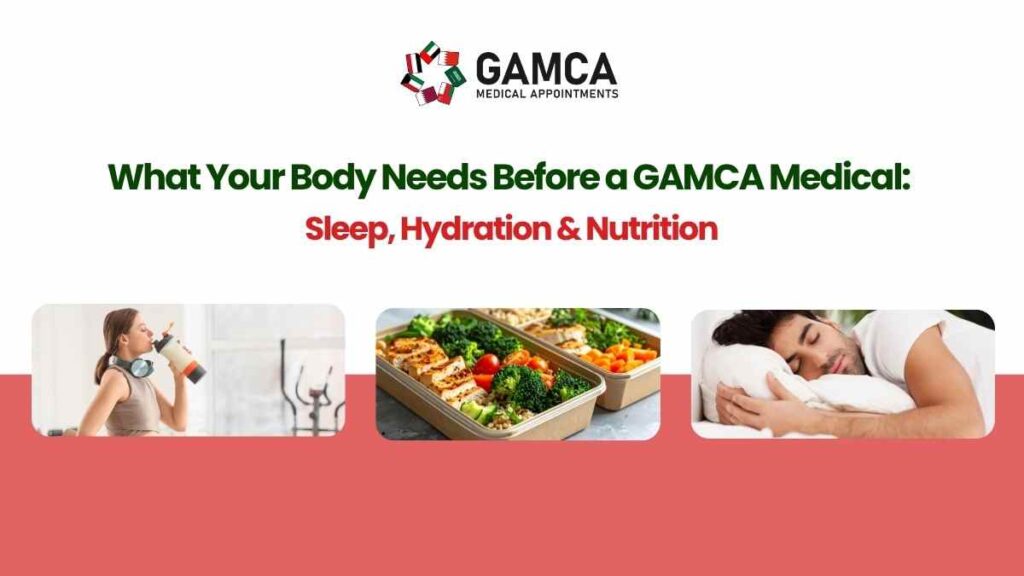
- Sleep: Give Your Body a Normal Night’s Rest
Let’s start with something that is often overlooked: sleep.
The night before an important medical examination can be stressful. You may be thinking about your visa, your job, your travel arrangements or whether your medical report will be satisfactory.
That anxiety can make it difficult to sleep.
Still, try to maintain a normal sleep schedule.
A good night’s sleep can help you feel:
- More alert
- Less tired
- More comfortable during the examination
- Better prepared to travel
- Less stressed about the process
You do not need to sleep for an unusually long number of hours.
The goal is simply to avoid deliberately staying awake late into the night.
What if you cannot sleep because you are nervous?
Don’t panic.
One imperfect night of sleep does not automatically determine your medical result.
Instead of repeatedly checking the time or searching for more medical advice online, prepare your documents, set your alarm and give yourself an opportunity to rest.
Your body does not need a “perfect” night. It needs reasonable rest.
- Hydration: Drink Normally, Not Excessively
Hydration is another area where applicants sometimes receive questionable advice.
You may hear that drinking large amounts of water before the examination will somehow “clean” your system or improve your medical results.
There is no reason to rely on this type of advice.
What should you do instead?
Maintain your normal water intake.
If you are thirsty, drink water.
If you are travelling in hot weather, pay attention to your body’s normal hydration needs.
But avoid suddenly consuming very large quantities of water immediately before the examination.
More water does not automatically mean better medical results.
In fact, excessive water consumption over a short period can be unsafe.
Your aim should be normal hydration — not water loading.
- What Should You Eat Before a GAMCA Medical?
There is no special “GAMCA diet” that you need to follow.
If you have not been instructed to fast, choose normal food that you are comfortable eating.
A balanced meal can include familiar foods such as:
- Rice or other grains
- Vegetables
- Fruits
- Eggs
- Fish
- Dal and other pulses
- Curd or other suitable dairy products
- Other normal sources of protein
The important word here is normal.
You do not need to suddenly start eating foods you have never tried before.
Likewise, you do not need to starve yourself because you are worried about your blood tests.
Your body is not something you can reliably “reset” with one meal.
- Should You Fast Before Your GAMCA Medical?
This is one of the most common questions applicants ask.
The answer depends on the instructions for your examination.
Do not assume that every applicant needs to fast.
If your medical centre has specifically instructed you to fast before a particular test, follow those instructions carefully.
If you have not received fasting instructions, do not decide to fast simply because someone on social media said that fasting is necessary.
What about tea and coffee?
If you have been instructed to fast, ask the medical centre what is permitted during the fasting period.
Different tests can have different preparation requirements.
When you are unsure, ask rather than guess.
This is especially important if you take regular medication or have a medical condition that could be affected by fasting.
- Don’t Try a Last-Minute Detox
Search for GAMCA medical preparation and you may come across advice about:
- Detox drinks
- Herbal mixtures
- Special juices
- Fasting for long periods
- Extreme water intake
- Unfamiliar supplements
- “Liver cleansing” methods
Be cautious.
A medical examination is not something you can reliably prepare for by trying to flush your body overnight.
If you have an underlying health issue, a detox drink will not make it disappear before your examination.
And taking an unfamiliar supplement shortly before a medical examination can introduce unnecessary complications.
Do not experiment with your health because you are nervous about your report.
If you are concerned about a particular medical issue, speak with an appropriate healthcare professional.
- Don’t Make Sudden Changes to Your Exercise Routine
Exercise is generally part of a healthy lifestyle, but the day before a medical examination is not the time to start an unusually intense workout.
For example, if you normally walk every morning, there is no need to stop.
But if you do not normally exercise and suddenly decide to complete a very intense workout because you want to “improve” your medical results, that is unnecessary.
Heavy exercise can leave you tired, sore or dehydrated.
Instead, keep your routine normal.
If you are interested in the broader relationship between physical fitness and GAMCA examinations, our guide Fitness for GCC Medical Exams: Exercise Tips for Better Test Results covers the subject in greater detail.
- What About Smoking and Vaping?
If you smoke or vape, you may wonder whether stopping immediately before the examination will change your medical results.
There is no sensible reason to depend on a last-minute change to hide an underlying health issue.
More importantly, smoking and vaping have broader implications for health.
If this is something you are concerned about, read our detailed guide:
Does Smoking or Vaping Affect Your GAMCA Medical? The Truth About Nicotine and GCC Visas
The important takeaway for your appointment is simple: do not assume that a few hours or one day of changing a habit can erase its effects on your health.
- What If You Recently Had an Illness?
This is another situation where last-minute preparation is not the answer.
If you recently recovered from an illness such as dengue or typhoid, you may wonder whether you should postpone your medical examination or whether your previous illness could affect your results.
The answer depends on your individual health situation and the applicable medical requirements.
Do not try to “fix” the situation by changing your food or water intake.
If you have recently recovered from dengue or typhoid, our separate guide may help you understand the issue:
What to Do If You Recently Recovered From Dengue or Typhoid Before the GAMCA Medical Test
If you are still unwell, have abnormal symptoms or are concerned about your recovery, speak with a healthcare professional.
- What About Existing Lifestyle-Related Health Concerns?
Some applicants become concerned about blood pressure, blood sugar, cholesterol, liver enzymes or other health measurements when they know that medical testing is approaching.
This can lead to extreme last-minute behaviour.
For example:
“I will stop eating completely.”
“I’ll drink only juice.”
“I’ll drink five litres of water.”
“I’ll take a supplement that promises to lower my numbers.”
This is not a sensible approach.
Your health is more important than trying to manipulate one day’s measurements.
If you have an existing health concern, work on it as part of your normal healthcare rather than waiting until the night before the examination.
For more information about lifestyle-related concerns and medical examinations, see:
Beyond the X-Ray: How Lifestyle Diseases Impact Your GAMCA Medical Success
You can also read How Lifestyle Choices Impact Your GAMCA Medical Results for a broader discussion.
- What Should You Do the Night Before?
The night before your appointment does not need to become a medical preparation project.
A simple routine is enough.
Prepare your documents
Keep your passport, appointment information and any other required documents together.
Eat normally
Unless you have been instructed to fast, eat a normal meal that you are comfortable with.
Drink water normally
Stay hydrated according to your normal routine.
Avoid experimenting
Do not try new supplements, extreme diets or detox products.
Get some rest
Give yourself enough time to sleep.
Check your travel route
Know where your assigned medical centre is and allow sufficient travel time.
This preparation is much more useful than spending hours searching for “how to pass GAMCA medical in one day.”
- What Should You Do on the Morning of the Examination?
Keep your morning straightforward.
Before leaving:
Check your appointment details.
Make sure you know where you need to go and when you need to arrive.
Follow any instructions from the medical centre.
If fasting has been specifically requested, follow the instructions.
Take medicines only as advised.
Do not stop prescribed medication without professional guidance.
Eat if you have not been instructed to fast.
Choose familiar food rather than something unusually heavy.
Drink normally.
There is no need to overload yourself with water.
Leave early.
Rushing to the medical centre can add unnecessary stress to an already important day.
If you want to understand what happens once you reach the centre, our article A Day at GAMCA Medical Examination Center provides a useful overview.
A Simple 24-Hour Preparation Guide
Here is the easiest way to think about it.
Time | What to Do |
|---|---|
Morning before | Continue your normal routine |
During the day | Eat normal, balanced meals |
Throughout the day | Drink water normally |
Evening | Organise documents and appointment details |
Night | Avoid unusual food, supplements and extreme routines |
Before bed | Get reasonable rest |
Morning of examination | Follow the medical centre’s specific instructions |
Before travelling | Check your documents and appointment details |
At the centre | Follow the instructions of the medical professionals |
The key is consistency, not last-minute correction.
What You Should NOT Do Before a GAMCA Medical
It can be useful to have a clear list of things to avoid.
Don’t:
- Drink excessive amounts of water in a short period
- Starve yourself unless instructed to fast
- Take unfamiliar supplements
- Try detox drinks
- Start an extreme diet
- Do unusually intense exercise
- Stop prescribed medication without medical advice
- Assume that one meal can change your medical condition
- Stay awake all night worrying about the result
- Rely on social media claims instead of instructions from your medical centre
Your medical examination should be approached as a health assessment, not a test that can be “gamed.”
Schedule your GAMCA medical appointment today!
What You Should NOT Do Before a GAMCA Medical
It can be useful to have a clear list of things to avoid.
Don’t:
- Drink excessive amounts of water in a short period
- Starve yourself unless instructed to fast
- Take unfamiliar supplements
- Try detox drinks
- Start an extreme diet
- Do unusually intense exercise
- Stop prescribed medication without medical advice
- Assume that one meal can change your medical condition
- Stay awake all night worrying about the result
- Rely on social media claims instead of instructions from your medical centre
Your medical examination should be approached as a health assessment, not a test that can be “gamed.”
What If You Are Worried About Your Medical Result?
This is probably the most human part of the whole process.
If your overseas job depends on your medical clearance, it is completely understandable to feel nervous.
But worrying about every possible result will not make the examination easier.
Instead, separate the things you can control from the things you cannot.
You can control:
- Preparing your documents
- Arriving on time
- Getting reasonable rest
- Eating normally
- Staying normally hydrated
- Following instructions
- Providing accurate medical information
You cannot control:
- The outcome of a medical assessment
- Test results related to an existing condition
- The medical professional’s findings
- Requirements that apply to your particular case
Focus on the first group.
That is the most useful preparation you can do.
Frequently Asked Questions
Yes. Try to maintain a normal sleep schedule and get reasonable rest. You do not need to force yourself to sleep for an unusually long time.
A poor night’s sleep can leave you tired and uncomfortable during the examination. However, one sleepless night should not be viewed as a way to deliberately change or control your medical result.
There is no single amount that applies to everyone. Maintain your normal hydration and avoid drinking excessive amounts of water immediately before the examination.
That depends on the specific instructions provided for your examination and the test being performed. If you have been told to fast, ask the medical centre what you are allowed to consume during the fasting period.
Eat a normal, balanced meal that you are comfortable with. There is no need for a special GAMCA diet.
Avoiding very heavy food can help you feel comfortable, particularly if oily food normally causes you discomfort. However, there is no universal rule that everyone must completely avoid oily food.
This depends on whether you have been instructed to fast and what your medical centre has advised. If fasting is required, confirm whether tea or coffee is permitted rather than assuming.
You can generally maintain your normal routine, but avoid unusually strenuous exercise that leaves you exhausted or dehydrated immediately before the examination.
Do not start taking new vitamins or supplements simply because you have a medical examination coming up. If you already take supplements or medication regularly and have concerns, speak with a healthcare professional.
There is no reason to rely on detox drinks to prepare for a medical examination. Avoid unfamiliar products, particularly immediately before testing.
Do not stop treatment or hide important medical information because of your appointment. If you are concerned about how an existing condition may affect your examination, speak with your doctor.
If you recently recovered from an illness, particularly one that may still affect your health or test results, discuss your situation with an appropriate healthcare professional and follow the medical centre’s instructions.
No food or amount of water can guarantee a “fit” medical result. The examination is intended to assess your health against the applicable requirements.
Keep preparation simple: sleep normally, eat normally, stay hydrated, follow the centre’s instructions, organise your documents and arrive on time.
The Best Preparation Is Normal Preparation
When an important medical examination is approaching, it is tempting to search for a shortcut.
You may look for a food that improves a blood test, a drink that cleans your system or a technique that helps you pass.
But your GAMCA medical is not something you should try to manipulate overnight.
The better approach is much simpler:
Sleep well.
Eat normally.
Stay hydrated.
Follow fasting instructions when required.
Avoid extreme last-minute changes.
Take prescribed medication responsibly.
Prepare your documents.
Arrive on time.
If you are still arranging your medical examination, GAMCA Medical Appointments can help you with the appointment process and provide information to help you prepare.
And if you want to understand the examination itself before attending, you can read What to Expect During Your GAMCA Medical Test: A Step-by-Step Guide.
Your goal is not to find a last-minute trick.
Your goal is to arrive prepared, informed and calm.
