Getting a job in a GCC country is an exciting opportunity for many international workers.
But receiving a job offer is only one part of the journey.
Before you can travel and start working, there are several formal steps to complete. One of the most important is the GCC medical examination.
For many people, the medical test can feel like just another document needed for a visa. In reality, it has an important purpose. GCC countries use expatriate medical screening to check whether workers are medically fit for the work or residence they are applying for and to help protect public health.
The Gulf Health Council’s expatriate screening program is specifically designed to assess the health fitness of expatriates and provide verified medical information to the relevant authorities before entry visas are issued.
So, if you are planning to work in Saudi Arabia, the UAE, Kuwait, Qatar, Bahrain, Oman or another GCC country, understanding the medical clearance process early can help you avoid unnecessary delays.
What Is GCC Medical Clearance?
GCC medical clearance is the medical fitness process that eligible expatriates complete as part of certain work or residence visa procedures.
The examination is carried out through approved medical facilities under the applicable GCC system.
The purpose is not simply to give you a general health check.
It is intended to determine whether you meet the medical requirements associated with your proposed employment or residence.
The Gulf Health Council states that its expatriate screening program is intended to ensure that expatriate workers are fit to work in GCC countries and to identify infectious diseases that could pose a risk to others.
Why Do GCC Countries Require Medical Clearance?
There are several reasons.
1.Protecting Public Health
People move across borders every day for employment.
Medical screening helps authorities identify certain infectious diseases and other conditions covered by the applicable health requirements.
The Gulf Health Council describes the program as part of a preventive health system for the Gulf community.
2.Confirming Fitness for Employment
Different jobs can have different physical and health requirements.
The purpose of medical fitness screening is to determine whether an applicant is medically fit for the relevant work or residence process.
3.Supporting the Visa Process
Medical results are connected electronically with the relevant authorities in the GCC medical screening system.
The Gulf Health Council explains that the system allows embassies, consulates and other relevant authorities to verify medical examination results before issuing entry visas.
This is why completing the medical examination correctly is an important part of the visa journey.
Is GCC Medical Clearance the Same as a Normal Health Checkup?
No.
This is a common misunderstanding.
When you visit your family doctor for a routine health check, the purpose is usually to understand your general health and identify potential health problems.
A GCC medical examination has a different purpose.
It is performed according to the requirements of the expatriate medical screening program and the applicable destination-country rules.
The examination may include different tests depending on the applicant and the relevant requirements.
So, completing a routine medical check at your local clinic does not necessarily replace the required GCC medical examination.
Who Needs a GCC Medical Examination?
This depends on the country, visa category and applicable rules.
In general, people travelling to GCC countries for employment or certain residence purposes may need to complete an approved expatriate medical examination.
For example, Saudi Arabia’s current permanent work visa process includes a medical examination and biometric fingerprinting as part of the visa procedure.
The exact requirements can change, so applicants should always check the requirements applicable to their specific destination and visa.
What Happens During the Medical Process?
The exact requirements can vary depending on your destination and visa type, but the process generally follows these steps:
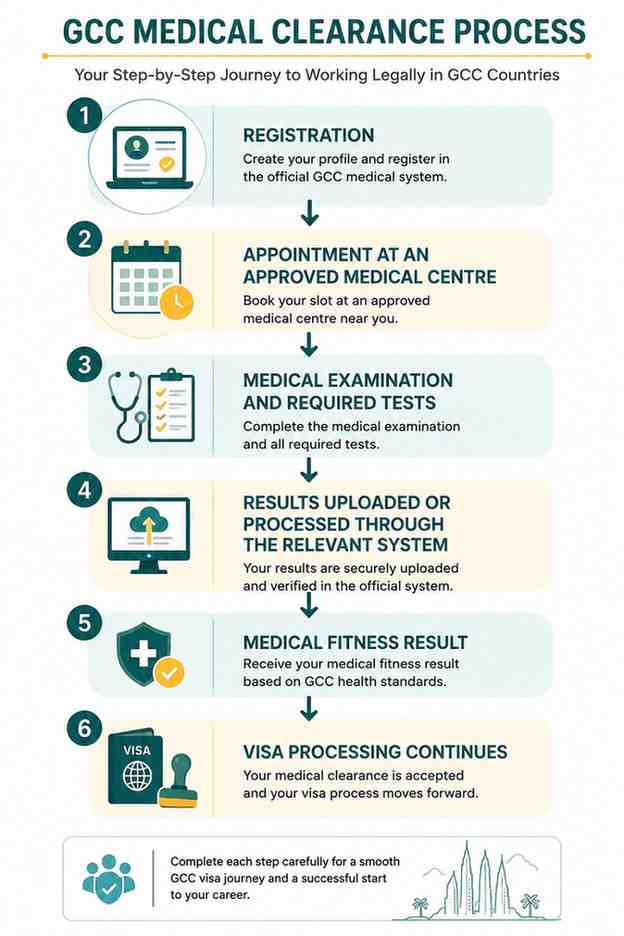
If you are arranging your GCC medical appointment, GAMCA Medical Appointments can help you understand the booking process and the steps you need to complete before attending your medical examination.
Need to arrange your appointment? Book Your GAMCA Medical Appointment
Why Is the Medical Centre Important?
Not every clinic can simply issue a medical report for the GCC visa process.
The medical examination needs to be completed through the approved system and an authorized medical facility.
The Gulf Health Council states that GCC embassies and consulates are committed to dealing with health centres accredited through the GCC expatriate examination system.
This helps reduce problems such as:
- Fake medical reports
- Incorrect results
- Unverified certificates
- Delays in visa processing
The electronic system also helps authorities verify medical results.
What Happens After You Complete the Medical Examination?
Once the required examination and tests are completed, the medical centre processes the results through the relevant system.
Your result may then be used as part of the visa process.
Depending on the destination and the applicant’s circumstances, other visa requirements may still need to be completed.
This is important:
A medical clearance does not by itself guarantee that a visa will be issued.
It is one part of the overall immigration and employment process.
What If Your Medical Result Is Not Clear?
Sometimes an applicant may not receive an immediate final result.
There can be administrative or medical reasons for additional processing.
For example:
- A test may need further review.
- Information may need verification.
- The medical centre may need to complete additional procedures.
- The result may still be processing.
If this happens, don’t immediately assume that your visa has been rejected.
First, check the medical status through the appropriate system and contact the medical centre if clarification is needed.
Can a Medical Result Affect Your Visa?
Yes.
Medical fitness can be a requirement for certain work and residence visa processes.
For example, Saudi Arabia’s official permanent work visa process states that the applicant must undergo medical examination before the visa process is completed.
The Gulf Health Council also explains that expatriate examination results are provided to embassies, consulates and other relevant authorities for verification before entry visas are issued.
However, applicants should remember that medical requirements are only one part of the visa process.
How Can You Avoid Delays?
A few simple steps can make the process easier.
Check your passport details
Make sure your name, passport number and date of birth are entered correctly.
Use an approved medical centre
Do not rely on unofficial clinics or agents promising shortcuts.
Keep your documents ready
Have your passport and other documents required for your specific appointment available.
Follow the medical centre’s instructions
If you are given instructions before the examination, follow them carefully.
Check your result
After the examination, use the appropriate official system to check the status of your medical report.
Don’t wait until the last minute
If your employment and visa timeline is tight, completing the medical process early can help you avoid unnecessary stress.
Why Medical Clearance Should Be Treated as an Early Step
Many applicants think about the medical examination only after everything else is ready.
That can be risky.
If your medical appointment is delayed, your report requires additional processing, or your information contains an error, other parts of your travel plan may also be affected.
That is why it makes sense to understand the medical process as early as possible.
Your journey might look something like this:
Schedule your GAMCA medical appointment today!
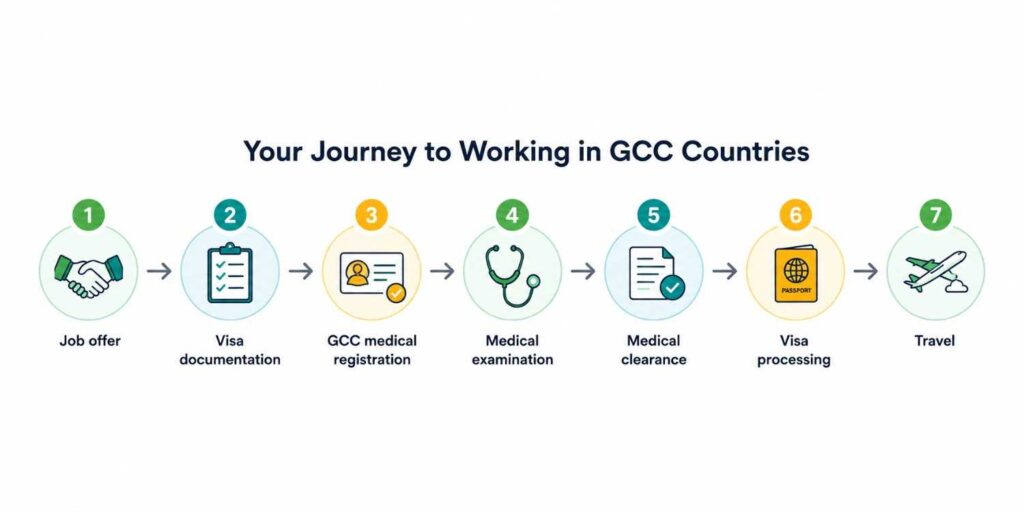
The exact sequence varies by country and visa type, but medical clearance is an important part of the journey for many GCC-bound workers.
GCC Medical Clearance Is About More Than a Certificate
It is easy to think of the medical examination as simply another document to collect.
But the system has a bigger purpose.
The Gulf Health Council describes the expatriate screening program as a preventive health system designed to protect the health of GCC communities while assessing the fitness of expatriates for work or residence.
For workers, the practical lesson is simple:
Understand the medical requirements early, use the approved process, provide accurate information, and keep track of your result.
That can make the overall visa journey much smoother.
Frequently Asked Questions
For many GCC work and residence visa processes involving expatriates, a medical examination is required. However, the exact requirement depends on the destination country, visa type and applicant. Saudi Arabia, for example, lists a medical examination as part of its permanent work visa process.
The terminology has changed over time. The current official platform is Wafid, operated under the Gulf Health Council’s expatriate medical examination program.
No. Applicants should use a GCC medical centre approved under the applicable GCC expatriate medical examination system. The Gulf Health Council specifically refers to accredited health centres within the program.
No. Medical clearance is one part of the visa process. Other requirements, documents and approvals may still be necessary.
Check your medical status through the relevant system and contact the medical centre if the result remains pending or requires clarification.
A routine health checkup is not necessarily a substitute for the required GCC expatriate medical examination. The examination needs to follow the applicable official process.
The program is designed to assess medical fitness and help identify certain infectious diseases and other health conditions covered by the applicable screening requirements.
Start by checking your destination-specific requirements, keeping your documents ready, using an approved centre, and following the centre’s instructions before the examination.
Final Thoughts
A GCC medical examination may seem like a small step compared with finding a job, obtaining a visa and planning your travel.
But it can be an important part of the process.
Getting it done through the correct channel, at the right time, and with accurate information can help you avoid unnecessary problems later.
If you’re preparing to work in a GCC country, don’t leave the medical process until the last minute. Understand the requirements, book through the appropriate system, complete your examination at an approved centre, and keep track of your medical result.
That way, you can move on to the next stage of your journey with greater confidence.
